
Heat Pump vs Air Conditioner: What’s the difference

Heat pumps provide both heating and cooling, while traditional air conditioning systems provide cooling only and require a separate heating source.
We are asked all the time…what is the difference between a heat pump and an air conditioning (AC) unit? The answer can range from a highly technical explanation to a simple overview. Since most of us are not HVAC technicians or physicists, for the purpose of this piece, our explanation will land somewhere in the middle.
The Overview
Heat Pumps and Air Conditioning units use the same basic system; however, they are deployed differently.
How does an Air Conditioning (AC) System Work?
Think of an air conditioning system as a heat transporter continually moving heat from one area to another, to where it is not needed.
The actual cooling happens when warm air is moved across coils cooled by refrigerant. At this point, moisture is removed, the temperature is lowered, and the cooled air is circulated into your house.
The scientific explanation of cooling is based on a process known as phase change: when a liquid converts to a gas, it absorbs heat.
A simple explanation of how an AC system uses phase conversion to cool air is this: A compressor pulls refrigerant, in gas form, from the evaporator coil inside your house to the condenser coil located in the outdoor AC Unit. Here, the big fan on your external AC unit draws heat from the refrigerant, returning it to liquid form. Now with the refrigerant back in liquid form, the process begins again.
It is through this endless cycle of refrigerant chilling the indoor air and subsequently moving heat outside that your home stays cool in the hot DFW summers.
HOW DOES A HEAT PUMP WORK?
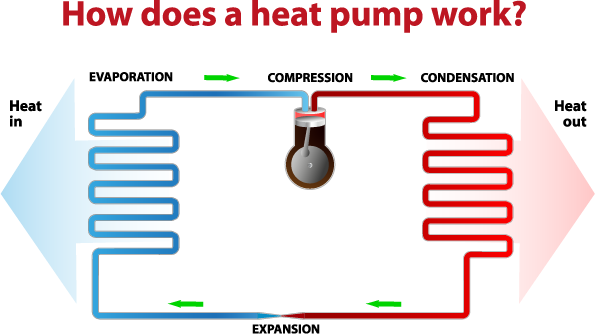
A heat pump transfers heat through four stages—evaporation, compression, condensation, and expansion—to efficiently heat and cool your home.
Think of a heat pump as a heat transporter continually moving heat from one area to another, depending on the season, to where it is needed or not needed. You will notice that this is the same definition we used to explain an air conditioning unit. That is because the science of cooling air is the same for a heat pump and an AC unit. The difference is that a heat pump can reverse the cycle to heat your home in the winter.
When it is warm outside, a heat pump is an air conditioner that moves heat out of your house, as explained above. When it is cold outside, a heat pump reverses direction and extracts heat from the outside, transferring it inside.
The question you are probably asking is how can cold air contain heat. Well, even when the air seems too cold, there are little bits of heat present. You know there is still heat outside when it is cold because it can always get colder.

Schedule Service
“Heat is present until the temperature reaches Absolute Zero (-459°F)”
A Heat pump is like a vacuum cleaner that gathers all those little bits of heat outside and pulls them inside to heat your house in the exact opposite way it cools your house in the summer.
One advantage of a heat pump, if you are 100% electric, is that you can save 30%-50% on your heating bill.
If you’re comparing the long-term operating costs of a heat pump versus a traditional heating and cooling system, you may also want to read our guide, “How Much Does a New HVAC System Cost?”
Compare Your Heating & Cooling Options
Whether you are considering a traditional air conditioner with a gas furnace or an energy-efficient heat pump, choosing the right system depends on your home, your comfort goals, and your budget. Compare your options with Extreme Comfort’s Instant Quote. Receive Good, Better, and Best HVAC system options with estimated pricing, delivered directly to your email within minutes, so you can confidently compare the systems that best fit your home.
Still have questions or wonder which system is best for your situation? We want to help. Contact an Extreme Comfort Advisor today. (972) 234-2336

Heat Pump vs. Air Conditioner FAQs
Q: Does a heat pump cool as well as an air conditioner?
A: Yes. During the summer, a heat pump cools your home exactly like a central air conditioner. Both systems use the same refrigeration process to remove heat and humidity from your home. The primary difference is that a heat pump can reverse the process to provide heat during the winter.
Q: Is a heat pump more energy-efficient than an air conditioner?
A: When cooling your home, similarly rated heat pumps and air conditioners have very similar efficiency. The advantage of a heat pump is that it also provides highly efficient electric heating, which can reduce heating costs for many homeowners.
Q: Can a heat pump replace both my air conditioner and furnace?
A: Yes. A heat pump can provide both heating and cooling. In colder climates, some homeowners choose a dual-fuel system that combines a heat pump with a gas furnace for maximum efficiency and comfort during extremely cold weather.
Q: Are heat pumps a good choice for North Texas?
A: Yes. Heat pumps perform very well in the Dallas-Fort Worth area because our winters are generally mild. They provide efficient summer cooling and can handle most winter heating needs, while reducing electricity costs for many all-electric homes.
Q: Do heat pumps work when it’s below freezing?
A: Yes. Modern heat pumps continue to provide heat below freezing, although efficiency gradually decreases as outdoor temperatures fall. Many systems include auxiliary or backup heat for extremely cold conditions, but in North Texas, those situations are relatively uncommon.
Q: Is a heat pump more expensive than an air conditioner?
A: A heat pump typically costs more than a comparable air conditioner because it provides both heating and cooling. However, the additional upfront investment may be offset by lower heating costs and the convenience of a single year-round comfort system.